
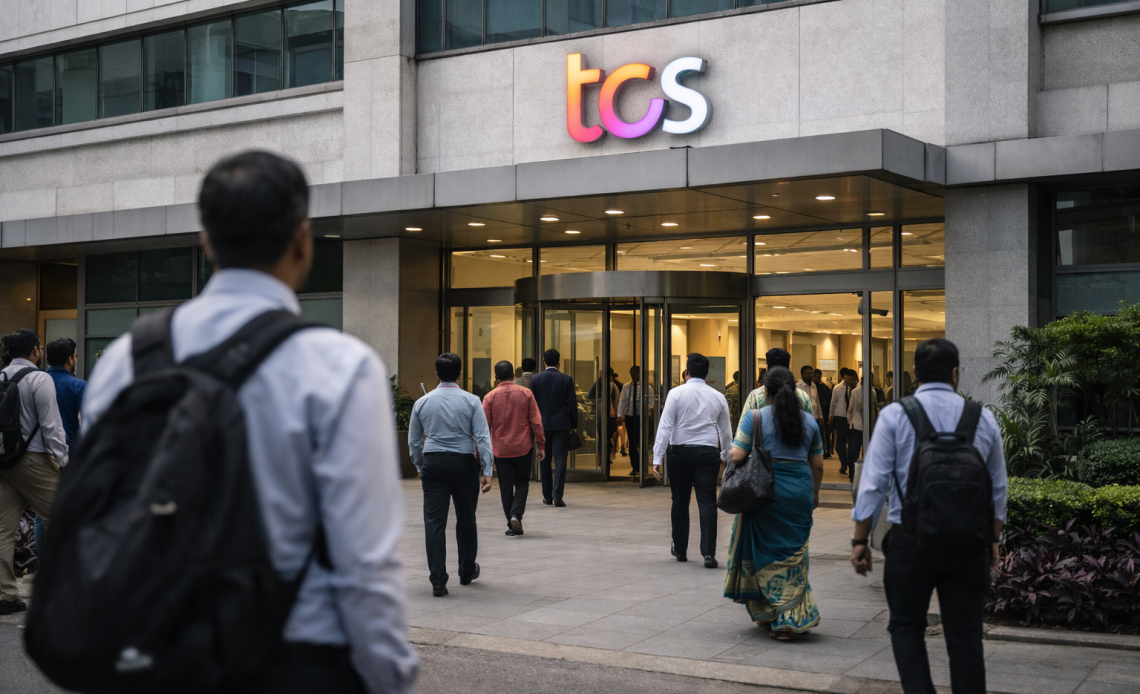
Indian information technology stocks witnessed their steepest weekly fall since the early days of the COVID-19 pandemic, wiping out nearly $50 billion in market value as investor anxiety over artificial intelligence, weak global cues, and fading hopes of US rate cuts converged into a sharp sell-off.
The rout gathered pace on Friday after a tech-led decline on Wall Street overnight, where concerns about shrinking margins dragged heavyweight stocks such as Apple lower and pushed investors toward safe-haven bonds ahead of key US inflation data.
The pressure on Indian IT stocks has been building for weeks, but accelerated sharply after fresh fears that rapid advances in generative AI could fundamentally disrupt the outsourcing-led business models that have powered the sector for decades.
Nifty IT sees sharp weekly decline since March 2020
The Nifty IT index fell as much as 5.2% on Friday before trimming losses to around 1.5% by mid-afternoon.
For the week, the index was down 9.4%, marking its steepest weekly decline since March 2020 when global markets were gripped by pandemic panic.
Over the past month, the index has fallen close to 15%, sharply underperforming the benchmark Nifty 50, which has declined just 0.8% over the same period.
Shares of Tata Consultancy Services and Infosys fell nearly 6% in early trade before paring losses.
By afternoon, TCS was down about 2%, while Infosys was lower by 1.4%. HCLTech slipped more than 1%, while Wipro declined around 2%.
TCS’s market capitalisation fell below ₹10 lakh crore on Thursday for the first time since December 2020.
Infosys, which has the highest mutual fund ownership among Indian IT companies, also dropped more than 5% on Thursday.
Since the sell-off began on February 4, domestic IT stocks have shed about 14%, pushing TCS from India’s fourth-most valuable stock to sixth place by market value.
AI launches spooking software investors
The immediate trigger for the latest bout of selling was the launch of a new AI tool by startup Anthropic last month, followed by an upgraded version of its Claude artificial intelligence model.
Anthropic said the latest version of Claude can work on tasks for longer durations and more reliably, with notable improvements in coding and finance-related functions.
These claims sharpened concerns that AI tools could automate routine software development and business processes, threatening revenue streams for IT services providers.
Those fears spilled over into Indian markets, where investors reassessed whether traditional outsourcing contracts could face pricing pressure as clients deploy AI to reduce manpower needs.
Wall Street slide and rate worries add to pressure
Sentiment deteriorated further on Thursday after Wednesday’s data showed US job growth unexpectedly accelerated in January while the unemployment rate fell, reducing the likelihood of near-term interest rate cuts by the Federal Reserve.
Rate cuts are widely seen as a key lever for reviving global technology spending, which has remained muted as enterprises curb discretionary budgets.
Indian IT firms, which derive a large share of their revenue from the US, are particularly sensitive to changes in demand from the world’s largest economy.
The broader technology sell-off in the US also weighed heavily on Indian markets, with investors increasingly questioning whether lofty valuations in global software and services stocks adequately reflect the risks posed by automation and AI-led efficiency gains.
Read More: Analysis: India reshapes Russian oil trade; market tightens as Moscow eyes China
IT services cos “plumbers in the tech world”: JPMorgan
Analysts at JPMorgan said the sell-off reflects growing concern that AI could erode both software and IT services demand.
“The bears argue that AI will eat into Software/SaaS and therefore reduce the scope of IT Services work, driving potential revenue declines,” the bank said in a note on Friday, pointing out that global software stocks have also come under pressure.
“In addition, there could be genuine fears of growth misses yet again due to AI crowding out spending, AI rate of change overwhelming enterprise discretionary spending decision making, thus lengthening sales cycles as Gartner (IT US) complained at its Dec earnings,” the analysts said.
However, JPMorgan cautioned against overly simplistic assumptions.
“It’s overly simplistic to assume that AI can automatically generate enterprise-grade software and replace the value IT services firms create across the cycle,” the note said, describing IT services companies as the ‘plumbers in the tech world.”
…if enterprise software/SaaS is rewritten on a bespoke basis by agents, it will need significant services plumbing to work in an enterprise context and minimise AI slop.
AI’s impact is uneven and slow to scale but not painless for Indian IT
Former Infosys chief executive and current Vianai CEO Vishal Sikka said the impact of generative AI will be uneven across sectors and roles.
“The biggest application, the biggest impact of generative AI, is software development and routine knowledge work,” Sikka wrote on X.
But this impact is not uniform. Melanie Mitchell wisely called it a ‘jagged frontier’—AI empowers some people and transforms some domains far more than others.
In an interview with CNBC-TV18 on Friday, Sikka said that while he has seen productivity gains to the tune of 20x-30x, enterprise adoption may take time due to the scale and legacy architecture of a large organisation.
“In the services industry, there are dozens of service lines. AI’s impact on those service lines is not all uniform. It doesn’t happen overnight to all of them. Some systems are much more complex than others, and so the rate of change is always as slow as the slowest pipe in the network,” he said in the interview.
Others see AI as a margin-enhancing force rather than an existential threat.
Ashi Anand, founder and chief executive of IME Capital, said AI could allow IT services firms to deliver the same projects with fewer people.
“What AI is going to allow is for IT services companies to execute the same size of projects with potentially substantially lower manpower because your manpower is that much more efficient,” Anand said in an interview with ET Now.
Jefferies struck a more cautious tone, warning that application services, which account for 40% to 70% of revenues for many Indian IT firms, could be vulnerable to AI-led disruption.
“There is more pain ahead for Indian IT,” Jefferies said, citing claims by Anthropic and Palantir that highlight the potential for AI to erode traditional services revenues.
The brokerage added that consensus growth estimates may not fully reflect these risks, posing downside threats to valuations.
JPMorgan’s four scenarios for the TCS, Infosys, HCL stocks
JPMorgan outlined four scenarios for large Indian IT firms.
“A reverse DCF implies TCS/INFO/HCLT are pricing in 4%/4%/5.6% 10 year rev CAGR, implying the sector is ex-growth or at terminal growth, sharply below the LT average (any period >3 years) of 7-8% growth. What can change this – if growth accelerates even slightly to MSD,” it wrote.
In an extreme bearish case, it assumes zero growth indefinitely due to AI disruption, implying potential downside of up to 39% for stocks of TCS, Infosys and HCL.
“In the uber-bear case, we assume 0% growth to perpetuity thanks to AI disruption for all 3 companies, which implies a potential downside of 36%/33%/39% for TCS/INFO/HCLT. This would require a few quarters of 0% growth to play out,” it said.
In a more moderate bearish scenario, growth stabilises at low single digits without recovery, suggesting stocks could bottom with downside ranging from 9% to 22%.
| Scenario | Core assumption | 10-year revenue CAGR assumption | Implied stock impact (TCS / Infosys / HCLTech) | JPMorgan’s interpretation |
|---|---|---|---|---|
| Market-implied (reverse DCF) | Current valuations reflect structurally low growth | 4% / 4% / 5.6% | Already priced into current stock levels | Market is treating Indian IT as ex-growth or terminal growth, well below the long-term average of 7–8% |
| Uber-bear case | AI disruption leads to zero growth indefinitely | 0% / 0% / 0% | –36% / –33% / –39% | Would require several quarters of zero growth; represents extreme downside if AI meaningfully replaces services demand |
| Reasonable bear case | Growth stabilises at low single digits with no recovery | 2% / 3% / 4% | –22% / –10% / –9% | JPMorgan sees this as a plausible bear-market bottom if growth fails to re-accelerate |
| Marginal improvement case | Gradual growth acceleration, but still below historical averages | 4.3% / 4.9% / 5.9% | +1% / +8% / +1% | Keeps stocks close to current levels, with limited upside despite modest recovery |
“In this scenario, we assume IT doesn’t enjoy any acceleration from the 2-3% growth in FY25-26 levels and remains stable. We assume rev CAGR of 2%/3%/4% for TCS/INFO/HCLT, which implies a potential downside of 22%/10%/9%. We think this is where stocks should bottom in a reasonable bear case.”
A marginal improvement scenario, where growth gradually accelerates but remains below long-term averages, would keep stocks near current levels with limited upside.
Marginal improvement keeps us close to current prices. In this scenario, we assume a gradual acceleration in growth from FY26 levels to MSD and stay well below the LT (5-10 year) average of 7-8%, and this doesn’t lead to any significant upside. We assume 4.3%/4.9%/5.9% rev CAGR over the next 10 years for TCS/INFO/HCLT, which implies potential upside of 1%/8%/1%.
Investors urged to avoid panic selling
VK Vijayakumar, chief investment strategist at Geojit Investments, said the market has entered a turbulent phase that could create both panic and opportunity.
“For the Indian market, this correction in AI stocks is a positive, because last year’s global rally was primarily an AI trade in which India, an AI laggard, couldn’t participate. So the unwinding of the AI trade, if it persists, is a positive from the Indian perspective,” he said.
“However, what is rattling the Indian market now is the massive sell-off in IT stocks, which is the second largest profit pool of India Inc. The real impact of the ‘Anthropic shock’ on the IT sector is yet to be ascertained. Panic selling in IT stocks at this stage may not be a good idea. Investors may wait and watch for the dust to settle.”
The post Inside the great Indian IT selloff: experts assess AI risks for Infosys, HCL and TCS appeared first on Invezz